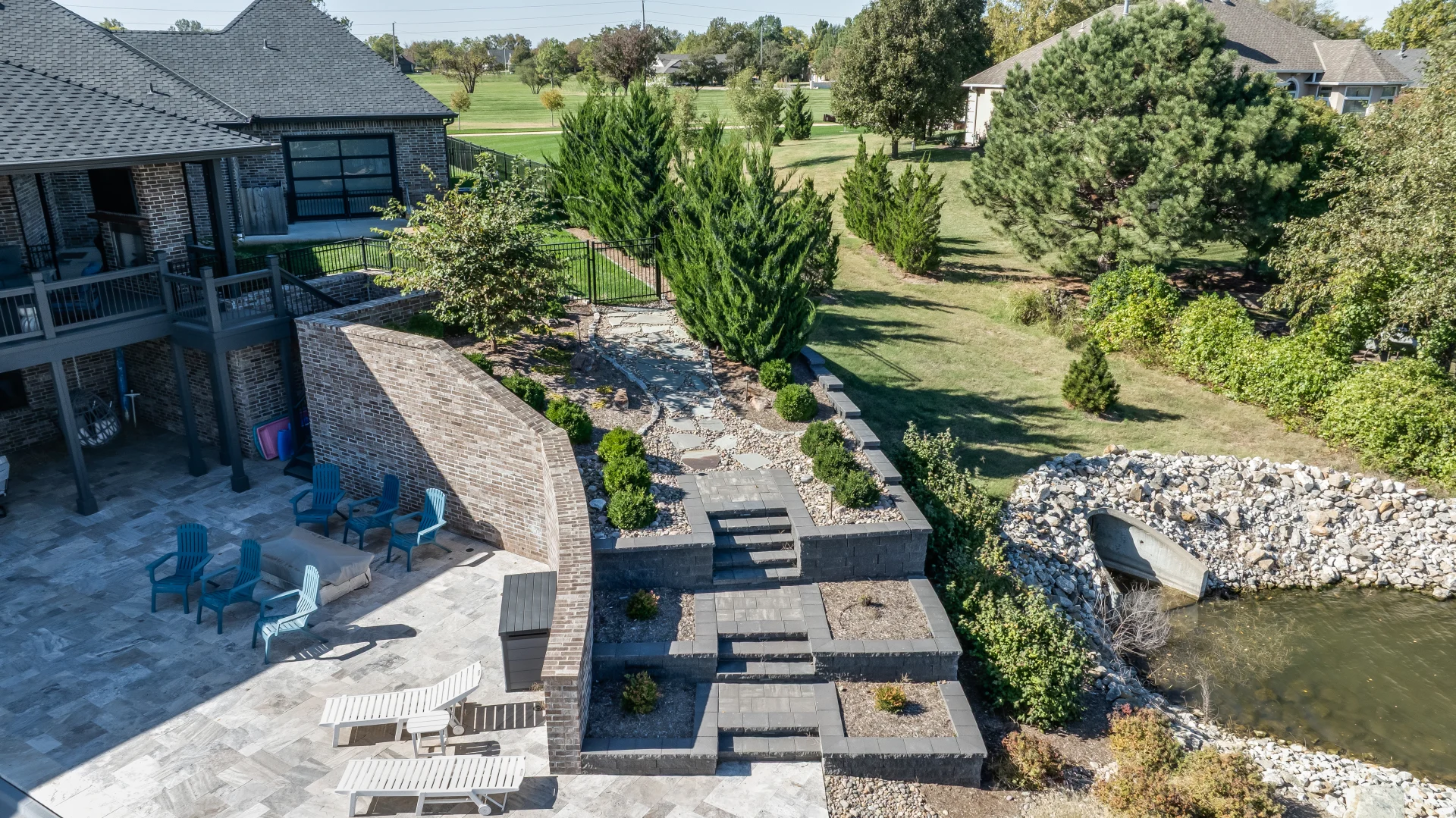
Between Cheney Reservoir’s well-documented swings and Kansas summers that can turn brutal in a hurry, drought-resilient landscaping is no longer optional for Wichita homeowners. It’s a genuine long-term strategy. Here’s what the Meadowlark team recommends.
Why drought planning matters more than ever in Wichita
If the past few years have taught Wichita homeowners anything, it’s that water security is never guaranteed. Cheney Reservoir, the city’s primary water source, dropped to its lowest level in over 50 years during the 2023-2024 drought cycle. The City of Wichita entered Stage 1 of its drought response plan in January 2023, escalated to mandatory Stage 2 restrictions in August 2024, and only returned to Stage 1 in September 2025. Stage 3, which would prohibit virtually all outdoor watering, remained a real possibility throughout that period.
The takeaway for homeowners is simple: even if Cheney is full today, drought conditions can develop faster than the reservoir can recover. Planning your landscaping with drought in mind protects both your investment and your community’s water supply. The USDA National Drought Monitor provides real-time Kansas drought data worth bookmarking year-round.
Understanding Wichita’s permanent outdoor watering schedule
Following years of drought stress, the Wichita City Council voted in August 2025 to make outdoor watering restrictions permanent. This isn’t a temporary measure. Regardless of Cheney’s level, a three-days-per-week odd/even schedule is now the baseline for all Wichita sprinkler irrigation. Check the official City of Wichita permanent outdoor watering schedule for complete details. This watering restriction applies to those using city water sources. Though it doesn’t apply to well water sources, using smart irrigation practices is still encouraged.
Odd Address (Ends in 1,3,5,7,9)
Wed, Fri, Sun
watering days allowed
Even Address (Ends in 0,2,4,6,8)
Tue, Thu, Sat
watering days allowed
No outdoor watering is allowed on Mondays, or between 10:00 a.m. and 6:00 p.m. on any day. The ideal window, according to K-State Extension research, is between 4 a.m. and 8 a.m., when evaporation and wind loss are minimal.
When drought conditions intensify, additional mandatory restrictions kick in. Under the Stage 2 restrictions Wichita experienced in 2024-2025, watering was reduced to one assigned day per week based on neighborhood quadrant, with no watering permitted Friday through Sunday. It’s worth understanding each stage before you need to respond to one on short notice.
Smart irrigation: work within the restrictions, not around them
A properly programmed irrigation system is one of the most powerful tools available to Wichita homeowners during drought. The goal isn’t to water more, it’s to water smarter, so that every allowed watering day counts.
Modern smart irrigation controllers connect to local weather data and automatically adjust run times based on temperature, humidity, and recent rainfall. They can be programmed by zone, allow for seasonal adjustments, and prevent the kind of wasteful mid-day watering that does little more than evaporate. If your current system is running on a fixed schedule set a few seasons ago, it almost certainly needs a refresh. The Meadowlark team offers sprinkler system management and seasonal programming as part of our lawn care services.
Want to know exactly how long to run each irrigation zone? Place a shallow flat-bottomed container, like a tupperware dish, in several spots across a single zone and run that zone for a set amount of time. Measure the water collected and calculate how long it takes to accumulate one inch. Repeat this for every zone, because different sprinkler heads deliver water at different rates. Once you know each zone’s output, you can set precise run times rather than guessing. Update these benchmarks at the start of spring, midsummer, and fall as your lawn’s water needs shift with the seasons.
The K-State Extension Office recommends what’s known as the “soak and cycle” method for irrigated Kansas lawns. Rather than running a zone for one long continuous session, you apply water in shorter intervals, allow it to absorb into the soil, then return to that zone. This is especially important in the Wichita area, where heavy clay soils can absorb only about two-tenths of an inch of water per hour. Dumping more than that at once leads to runoff and waste. K-State’s WaterWise Irrigation resources walk through the method in detail.
How to know if your lawn is getting enough water
Most lawns in the Wichita area need one to one-and-a-half inches of water per week during the active growing season to stay green. During peak summer heat, that requirement can climb. Under Wichita’s permanent watering restrictions, hitting that target requires knowing your system’s output by zone, not just running it by feel.
A few quick ways to assess whether you’re watering enough:
Walk across your lawn in the morning. If your footprints remain visible rather than springing back, the grass is stressed and needs water. Watch for a blue-gray cast developing on the turf, another sign of moisture deficit. You can also use a simple soil probe or screwdriver: if it slides easily six inches into the ground, moisture is adequate. If it stops at one or two inches, your root zone is dry.
On the flip side, overwatering is a real problem too. Soggy soil, mushroom growth, and thatch buildup are signs you may be putting down too much. Shallow-rooted grass that has always been watered lightly and frequently is also more vulnerable when drought restrictions cut that frequency.
Moisture Manager: a smarter lawn care add-on for dry conditions
One of the services Meadowlark offers that makes a measurable difference during drought stress is the application of a Moisture Manager soil amendment as part of your regular lawn care regimen. Moisture Manager is a soil surfactant that improves water penetration and distribution through the soil profile, helping your lawn make better use of the water it does receive. For Wichita’s clay-heavy soils, which naturally resist water infiltration, it can be a meaningful advantage when watering days are limited. Ask your Meadowlark technician whether adding Moisture Manager to your program makes sense given your lawn’s soil type and current condition.
Choose native and drought-tolerant plants
One of the most durable long-term moves a Wichita homeowner can make is shifting landscape beds toward native and drought-adapted plants. Native plants are acclimatized to Kansas rainfall patterns, which means they can handle extended dry periods without supplemental irrigation once they’re established.Check out our favorite low-maintenance drought resistant plants for Wichita gardens. We’ve also curated a list of perennials and annuals that add color to your garden and do well in our Kansas heat.
Replacing water-intensive turf in low-use areas with native ground covers, ornamental grasses, decorative rock, or mulched beds also reduces the overall irrigation demand on your property. Less lawn to water means more flexibility when restrictions tighten. The Meadowlark team can help you identify which beds and border areas are good candidates for conversion.
For lawn grass, warm-season options like zoysia and buffalo grass use significantly less water than cool-season fescue blends during the heat of summer, and they’re well suited to Kansas conditions. If you’re overseeding or renovating, ask us about the best grass selection for your sun exposure and soil type.
Keep weeds under control before they drain your lawn
This one often gets overlooked in drought conversations, but weed pressure is a genuine water-efficiency problem. Weeds compete aggressively for soil moisture, nitrogen, and root space. A lawn that’s already stressed by drought restrictions and high heat becomes increasingly vulnerable to weed encroachment, and once weeds establish, they can overtake the desirable turf quickly.
Staying ahead of weed pressure with pre-emergent applications in early spring and targeted post-emergent treatments throughout the season keeps your grass in a position to compete. A thick, healthy lawn is also its own best defense against weeds. Deep, infrequent watering promotes the strong root development that makes turf more resilient. Regular mowing at the right height, typically two-and-a-half to three inches for most Wichita lawns, shades the soil and discourages weed germination. Meadowlark’s full-season 5-step lawn care program addresses weed control as an integrated part of keeping your lawn healthy under stress.
A connected approach: drought planning, irrigation, and ongoing lawn care
Drought-resilient landscaping isn’t a single decision. It’s a system of interrelated choices: the right plants, properly calibrated irrigation, smart soil management, and consistent weed and pest control. Any one of those elements working poorly puts stress on the others.
The Meadowlark team works with Wichita homeowners throughout the season to manage all of it together. From spring sprinkler startup and zone calibration to Moisture Manager applications, weed treatments, and plant selection guidance, we can help you build a yard that holds up under Wichita’s demanding summers without wasting water you may not have.
Sources & further reading
City of Wichita — Permanent Outdoor Watering Schedule
City of Wichita — Drought Update & Current Stage
USDA National Drought Monitor — Kansas Drought Conditions
USGS Water Data — Cheney Reservoir Monitoring
K-State Extension — WaterWise Irrigation, Sedgwick County
K-State Extension — Irrigating Your Lawn